
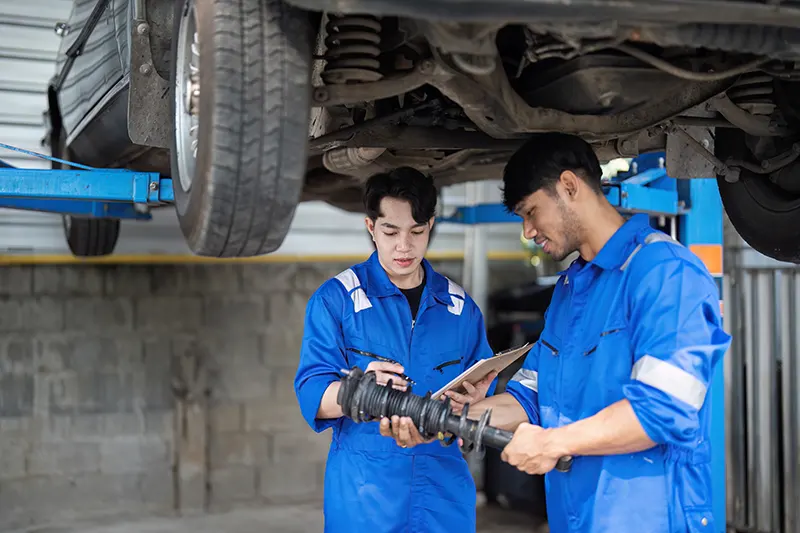
Your vehicle’s steering and suspension systems are absolutely critical for maintaining a smooth ride and ensuring stable handling on the road. Over time, daily encounters with potholes, speed bumps, and rough pavement cause these intricate components to wear down and lose their alignment.
Ignoring subtle changes in how your car steers or rides can lead to dangerous handling characteristics and expensive secondary damage. Scheduling a timely professional inspection keeps you in complete control of your vehicle and prevents minor component wear from turning into a major mechanical failure.
After Experiencing A Harsh Curb Or Pothole Impact
Even a single violent encounter with a deep pothole or a concrete curb can instantly bend steel control arms or crack vital steering linkages. When your suspension takes a direct, heavy hit, the precision geometry of the entire front end gets severely disrupted.
- Visually inspect your wheels for fresh scuffs or dents after striking a major road hazard.
- Pay close attention to whether your steering wheel now sits off-center when you are driving completely straight down the highway.
- Listen for any new popping or metallic clicking sounds when you travel over minor imperfections in the asphalt.
A sudden, forceful impact can turn a perfectly safe vehicle into a safety hazard in a fraction of a second. Having a mechanic put your car on a lift right after a bad bump guarantees that no hidden structural damage goes unnoticed.
When Your Tires Show Uneven Or Premature Tread Wear
Your tires act as an early warning billboard for the hidden health of your underlying suspension components. When shocks, struts, or ball joints fail to hold the wheel firmly against the road, the tires begin to wear down in erratic, highly unusual patterns.
- Run your hand across the tread of your tires to feel for wavy, high-and-low ridges, which mechanics refer to as cupping.
- Check if the inner or outer edges of the tire rubber are bald while the center still has plenty of tread remaining.
- Look for smooth patches on the tire shoulders that indicate the wheel is leaning too far inward or outward while driving.
Abnormal tread wear means your tires are scrubbing against the road surface instead of rolling smoothly over it. Spotting these patterns early allows you to save your expensive tires by correcting the suspension issue before the rubber is completely ruined.
If The Vehicle Pulls Consistently To One Side
Driving down a flat, level road should require very little physical effort to keep your vehicle traveling in a straight line. If you find yourself constantly fighting the steering wheel or applying continuous pressure to stay in your lane, your alignment is heavily compromised.
- Safely and briefly relax your grip on the steering wheel on a straight road to see if the car drifts immediately toward the shoulder.
- Notice if the vehicle yanks hard in one direction whenever you apply the brakes or accelerate away from a stoplight.
- Feel for an annoying, persistent drift that forces you to hold the steering wheel at an awkward angle just to go straight.
A vehicle that pulls forces your engine to work harder and dramatically increases driver fatigue during long road trips. A professional inspection will pinpoint whether a worn tie rod, a bad wheel bearing, or a collapsed spring is causing the vehicle to drift.
When You Notice Excessive Bouncing Or Vehicle Dipping
The primary job of your shocks and struts is to damp the energy of your vehicle’s springs and keep the chassis completely stable. When these components lose their hydraulic fluid, your vehicle will begin to ride like a boat on rough water.
- Count how many times the front end bounces after you clear a standard neighborhood speed bump.
- Watch for a dramatic nose-dive effect where the front of the car dips heavily toward the ground whenever you press the brake pedal.
- Observe if the rear of the vehicle squats excessively when you have passengers in the back seat or cargo in the trunk.
A bouncy suspension dramatically increases your stopping distance and makes your vehicle highly unstable during emergency maneuvers. Replacing worn-out dampening components restores your ride quality and keeps your tires firmly planted on the pavement where they belong.
If You Discover Leaking Fluid On Your Suspension Components
Shocks and struts rely on internal hydraulic fluid to properly cushion your ride and absorb harsh road impacts. Once the rubber seals around these components dry out and crack, the vital fluid escapes and coats the outside of the part.
- Look behind your front wheels with a flashlight to see if the shock absorbers look wet, greasy, or covered in dark grime.
- Check your driveway for mysterious oily spots located directly inside the footprint of your front or rear axles.
- Inspect the rubber boots surrounding your steering rack and ball joints to see if they are torn and weeping fluid.
A wet or grease-covered suspension part is a definitive sign of an active component failure that cannot be ignored. Once the hydraulic fluid escapes entirely, the part will stop functioning altogether and cause rapid wear to the rest of the system.
Prioritize Your Road Safety And Control Today
Investing in a professional steering and suspension checkup is one of the smartest ways to protect both your wallet and your peace of mind. Catching worn bushings or loose linkages early keeps your repair bills manageable and ensures your vehicle handles predictably in an emergency situation.
Do not wait for a complete component failure to leave you stranded on the side of the road or facing a massive repair bill. Take charge of your vehicle’s health by booking an inspection the moment your ride begins to feel loose, bumpy, or unpredictable.
